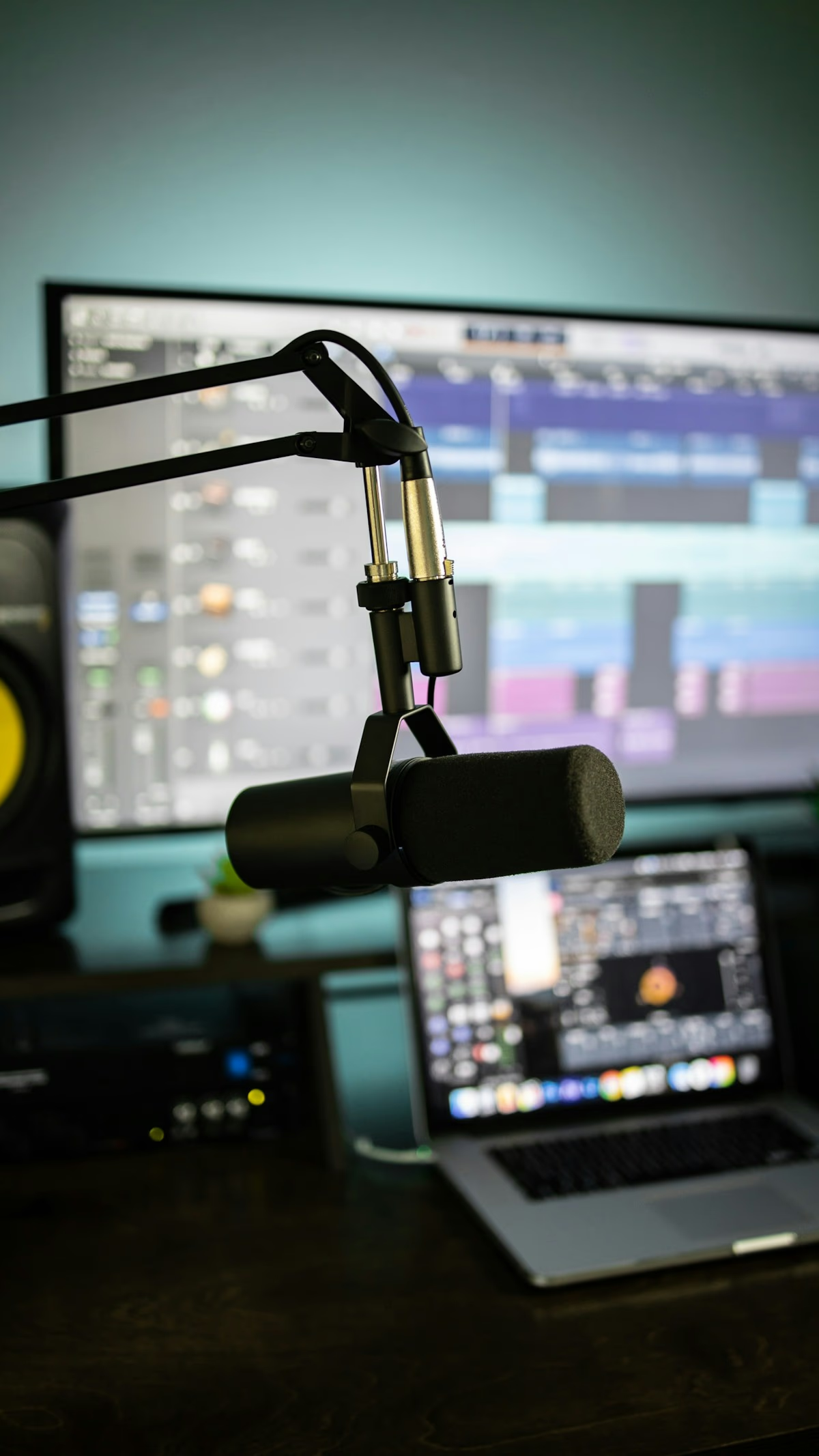
Warehouse Techno Sounds 2026: Gear, Plugins & Techniques
What Defines the Warehouse Techno Sound in 2026
The warehouse techno aesthetic in 2026 is built on tension. It is raw, industrial, and deliberately unpolished. Producers working in this space are pulling from a lineage that runs through Detroit, Berlin, and Sheffield, but the current iteration has its own distinct character: heavier sub-bass, more aggressive transient shaping, and a renewed focus on hardware-influenced textures.
This is not bedroom pop. The sounds that work in a 3,000-capacity warehouse are built to cut through concrete and crowd noise. Understanding what makes those sounds work technically is the difference between a track that sounds like techno and one that actually functions as techno.
The Core Sonic Pillars
Three elements anchor the warehouse techno palette in 2026:
Kick drums with physical weight. The kick is not just rhythmic. It is structural. Producers are layering transient-rich attack samples with long, tuned sub tails, often using tools like Kick 2 by Sonic Academy or analog-modeled drum machines to achieve a punch that translates across sound systems.
Industrial texture and noise. White noise sweeps, mechanical clanks, and degraded samples are not accidents. They are design choices. Bit crushing, tape saturation, and ring modulation are standard processing steps for adding grit without losing clarity.
Hypnotic, looping tension. Warehouse techno does not resolve. It builds and sustains. Arrangement choices favor long loops with subtle modulation rather than dramatic drops, keeping dancers locked in a state of anticipation.
Essential Hardware and Software for 2026 Warehouse Techno
Drum Machines and Rhythm Tools
The Roland TR-8S and Elektron Rytm MKII remain foundational, but 2026 has brought renewed interest in more esoteric hardware. The Vermona DRM1 MKIII offers analog drum voices with a rawness that digital emulation still struggles to fully replicate. For producers working entirely in the box, Native Instruments' Battery 4 and XO by XLN Audio provide sample-based workflows with strong techno-specific libraries.
Pattern-based sequencing is critical. Euclidean rhythm generators, whether hardware or plugin-based, help create the off-kilter groove that separates warehouse techno from four-on-the-floor house.
Synthesizers for Industrial Texture
Acid basslines built on the TB-303 template are still present, but 2026 warehouse techno leans harder into modular and semi-modular synthesis. The Moog Matriarch and Make Noise 0-Coast are popular semi-modular entry points. For software, Arturia's Pigments offers wavetable, virtual analog, and granular engines in one interface, making it particularly versatile for sound design.
Distortion and saturation are not finishing touches. They are part of the synthesis chain. Running oscillators through overdrive before they hit the filter creates harmonic complexity that sits well in dense mixes.
Mixing and Mastering Considerations
Warehouse systems are loud and often poorly treated acoustically. Mixes need to be mono-compatible, bass-managed carefully, and transient-controlled. Sidechain compression between kick and bass is standard, but 2026 producers are also sidechaining mid-range elements to create rhythmic breathing in the texture layer.
Limiters from Fabfilter (Pro-L 2) and iZotope (Ozone 11) are widely used for final loudness shaping, but experienced producers know that the arrangement itself should do most of the dynamic work before mastering is involved.
Production Workflow: Building a Warehouse Techno Track
Starting with the Kick-Bass Relationship
Begin with the kick and bass as a unit, not as separate elements. Tune the sub of the kick to the root note of the bassline. Use a high-pass filter on the bass during kick transients to avoid frequency collision. This relationship determines whether the track has physical impact or just volume.
Layering Percussion for Depth
Stack at least three percussion layers: a transient-heavy top layer for click, a mid-body layer for punch, and a sub layer for weight. Process each layer separately before summing. Parallel compression on the drum bus adds density without killing dynamics.
Modulation and Movement
Static sounds do not work in long techno sets. Use LFOs tied to filter cutoff, reverb send levels, and stereo width to create subtle movement across the arrangement. Automation should feel organic, not mechanical, even when it is precisely programmed.
Explore our guides on mixing low-end for club systems and sound design fundamentals for electronic music producers for deeper technical context. (Internal link opportunities: low-end mixing tutorial, electronic sound design guide, techno arrangement tips.)
Frequently Asked Questions
What BPM range is standard for warehouse techno in 2026? Most warehouse techno tracks in 2026 sit between 135 and 145 BPM. Some harder industrial-leaning tracks push toward 148 to 150 BPM, but the sweet spot for most club contexts remains around 138 to 142 BPM.
Do I need hardware to make authentic warehouse techno sounds? No. While hardware adds a tactile workflow and certain analog characteristics, modern plugins like Arturia's V Collection, Native Instruments Massive X, and various modular emulators can produce warehouse-ready sounds entirely in the box. The processing chain and arrangement decisions matter more than the source.
How do I make my techno mixes sound good on large sound systems? Reference your mix on multiple playback systems, including mono. Keep the sub bass (below 80 Hz) centered and controlled. Use a spectrum analyzer to check for frequency buildup in the 200 to 400 Hz range, which often causes muddiness on large systems. Test with a limiter at -1 dBTP to ensure headroom for mastering.
If you are building your techno production toolkit, review our curated plugin lists and DAW-specific workflow breakdowns for genre-focused guidance. (Internal link opportunities: best plugins for techno, DAW workflow for electronic music, club music mixing guide.)